Streaming Speech-to-Text, November 2026
Three local models on a CPU against ElevenLabs Scribe v2 and the new Scribe v3, measured on accuracy, speed and how much the text moves
Every couple of months I post a short "as of" comparison of streaming speech-to-text, the kind of engine that turns live audio into words while someone is still talking. I build voice products, so I care which one to put behind a microphone. This is the first time I'm writing up the full method, because this round changed enough to need it.
Five engines this time. Three run locally on a CPU through parakeet.cpp. They are NVIDIA's Parakeet realtime 120M, Nemotron 3.5 streaming (0.6B), and the newer Nemotron Labs Unified ASR (0.6B). Two are cloud APIs from ElevenLabs, Scribe v2 Realtime and the new Scribe v3 Live, released on November 10.
Three numbers, no cup holders
A car review tells you how it drives, how it stops and what it costs to run. It doesn't spend three pages on the cup holders. I measured a lot of small things while building this harness, and most of them don't change which engine you should pick. So the post sticks to the three that do.
- Accuracy. Word error rate on the final transcript, the share of words that came out wrong.
- Speed. How long after the speaker stops until the last word is on screen. This is the wait a user actually feels.
- Stability. How many of the words shown on screen later change. A streaming engine shows its best guess early and may revise it. Revisions make captions jump, and an agent that reacts to early text reacts to words that turn out to be wrong.
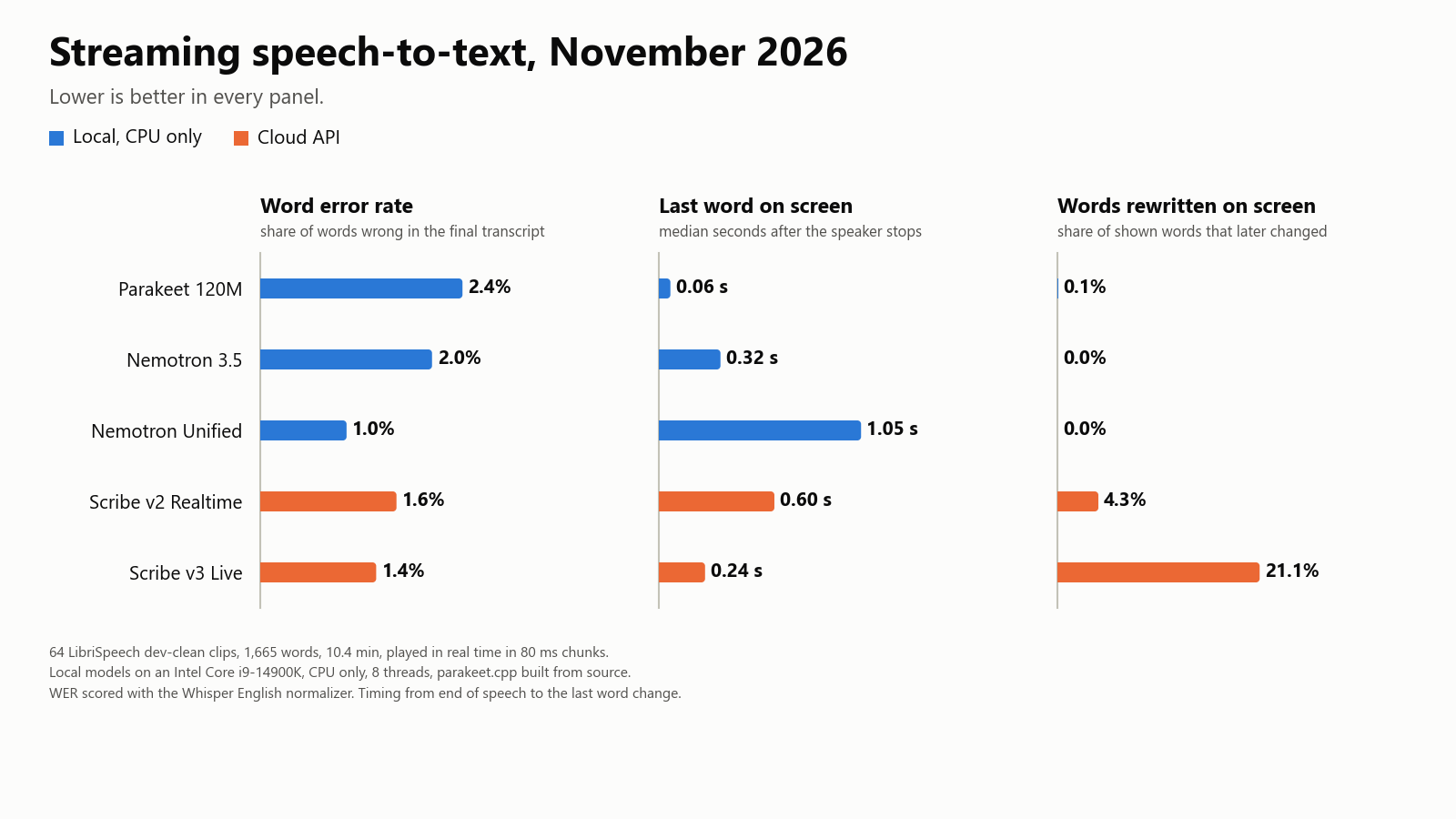 Word error rate, time to the last word, and share of words rewritten for five streaming speech-to-text engines
The results
64 clips, 32 speakers, 1,665 words, 10.4 minutes of audio, each clip played in real time.
| Engine | Runs on | Word error rate | Last word, median | Last word, slow case (p90) | First word, median | Words rewritten |
|---|---|---|---|---|---|---|
| Parakeet 120M | Local CPU | 2.4% | 0.06 s | 0.28 s | 0.44 s | 0.1% |
| Nemotron 3.5 | Local CPU | 2.0% | 0.32 s | 0.56 s | 0.67 s | 0.0% |
| Nemotron Unified | Local CPU | 1.0% | 1.05 s | 1.35 s | 1.37 s | 0.0% |
| Scribe v2 Realtime | Cloud | 1.6% | 0.60 s | 0.91 s | 1.73 s | 4.3% |
| Scribe v3 Live | Cloud | 1.4% | 0.24 s | 0.95 s | 0.60 s | 21.1% |
What stood out
Nemotron Unified was the most accurate engine in the test, and it runs on a CPU. It got 17 words wrong out of about 1,670. Scribe v3 got 23 and Scribe v2 got 27. The gap between the two Scribe models is a handful of words on one pass, so I wouldn't call a winner between them. Unified's lead is larger than that. The price is time. Unified works on about 1.1 seconds of audio at a time, look-ahead included, before it commits to words, so the last word shows up about a second after the speaker stops. When I shortened that window to about half a second, it fell behind real time on this CPU.
Scribe v3 Live is fast to show words and slow to settle on them. It put the first word on screen in 0.60 seconds, almost three times sooner than Scribe v2. Then it changed about one in five of the words it had shown. Scribe v2 changed about one in twenty-three. Its median finish is quick at 0.24 seconds, but in the slower tenth of clips it took 0.95 seconds, the same as v2. I ran v3 in my own live-transcription app for a couple of days and moved back to v2, because the live text kept shifting under me.
Parakeet 120M is the fastest thing here by a wide margin. The last word appeared 0.06 seconds after the speaker stopped, at the cost of the highest error rate in the group. For anything that has to react the moment someone stops talking, such as turn-taking in a voice agent, that tradeoff can be worth it.
All three local models kept up with real time on a CPU, with room to spare. On 8 threads of a desktop CPU they used between 11% and 33% of real time. No GPU, no per-minute bill, and the audio never leaves the machine. The cloud engines need no hardware and handle the scaling for you, and you pay per use and depend on the network.
Which one I'd pick
- Live captions or a voice interface where text shouldn't jump. Nemotron 3.5 locally, or Scribe v2 in the cloud.
- Best accuracy, and a one-second wait is fine. Nemotron Unified, for notes, transcripts and anything read after the fact.
- Fastest reaction, with a few more errors accepted. Parakeet 120M.
- Scribe v3 Live. Use it when you only need the final text, or when you show early words greyed out until they settle.
How I measured
- Audio. 64 clips from LibriSpeech dev-clean, 32 speakers, sent in 80 millisecond chunks at the moment a live microphone would have them. Every engine got the same audio on the same schedule.
- Accuracy. Both the reference and each engine's final text go through the Whisper English normalizer before scoring, so capital letters, punctuation and number formats don't count as errors.
- Last word on screen. Measured the same way for every engine, from the end of speech in the clip to the last moment the words on screen changed. ElevenLabs also sends an end-of-turn signal after a silence setting, which I set to 1.0 second. That signal is a separate feature, so it isn't in these numbers.
- Words rewritten. Every time the screen updates, any word that was showing and didn't survive the update counts as rewritten. Unchanged words around a correction don't count, and a final word that is still being spelled out doesn't count either.
- Local setup. Intel Core i9-14900K, CPU only, 8 threads, 16-bit weights, parakeet.cpp built from source at commit 2eac2e7. Nemotron 3.5 ran at its default 320 millisecond chunk and Unified at its default 1.12 second window.
- Cloud setup. ElevenLabs realtime API, English, no custom vocabulary.
- Runs. One pass per engine over all 64 clips, all from one frozen version of the harness, with no failed runs.
Limits
LibriSpeech is read speech, recorded clearly. Phone calls, meetings and noisy rooms are harder for every engine, and the ranking could change there. This is one pass on 64 clips, so differences of a few words are noise. These numbers aren't comparable with my June and August posts, which used two clips and a different set of engines. Google's Gemini live transcription wasn't part of this round.
Next round I'll add conversational audio with crosstalk and background noise, which is closer to how these engines get used.